

Employee communication: How to keep your team informed

Many companies today have numerous communication channels—email, chat, project tools, and meetings. Nevertheless, the same problem often arises in everyday work: employees are not reliably on the same page. Decisions do not reach everyone, priorities are understood differently, and important updates get lost in day-to-day business. Missing or delayed information has a direct impact on efficiency, quality, and collaboration—because those who are not informed in a timely manner or completely cannot perform tasks reliably and purposefully.
This is precisely where employee communication comes in. Successful employee communication does not mean sending even more messages, but rather structuring information in such a way that it is understandable, easy to find, and available to the right people. The key question here is: What information needs to be accessible when, via which channel, and to whom? In this article, we show you the basics of good employee communication and the measures companies can use to keep their teams informed at all times – regardless of whether employees work on site, in a hybrid model, or remotely.
Why good employee communication is crucial
Employee communication ensures that teams have a common level of information and clearly know what is relevant in their day-to-day work. When decisions, priorities, and changes are communicated reliably, employees work more efficiently, with greater confidence and clarity. This has several concrete advantages:
- More motivation and commitment: Employees feel more involved when they understand goals, backgrounds, and decisions.
- Fewer queries and less duplication of work: Clear information reduces misunderstandings and unnecessary coordination.
- More trust and a better culture: Transparent employee communication prevents uncertainty and rumors.
- Faster implementation: Decisions are understood more quickly and implemented more consistently.
It is important to note that communication problems are rarely a “people problem.” In most cases, they are a structural problem—for example, due to unclear channels, a lack of routines, or undocumented information. Well-organized employee communication can help remedy this situation.
The most common reasons why teams are not informed
When teams are not on the same page, it is rarely due to a lack of communication—often, the opposite is true. Information is shared in many places, but not in a way that ensures it reliably reaches everyone. Typical causes include:
- Too many channels without clear rules: When updates are sometimes sent by email, sometimes in chat, sometimes in meetings, and sometimes in the project tool, confusion arises. Employees then don’t know where to look—and important information gets lost.
- Knowledge silos created by individuals: Key information is often tied to specific employees or managers. If this person is absent or does not pass on content, others are left out.
- Decisions are not communicated consistently: Decisions are often made in meetings or small groups, but are not documented afterwards or passed on to relevant teams. Context and reasoning are missing.
- Unclear responsibilities: If it is not specified who communicates updates, they often do not happen at all—or they happen multiple times and are contradictory. Gaps arise particularly at interfaces between teams.
- Information overload without prioritization: When everything is considered “important,” nothing is really noticed anymore. Employees filter information themselves—and key messages disappear in the flood of news.
- Missing routine formats: Without regular updates (e.g., weekly or team status), employee communication is often reactive. Information is shared when something is urgent—not when it would be useful.
- A typical result looks like this: The project manager informs sales, sales informs support—but production only finds out a week later. Such breaks in the flow of information can be avoided with clear communication channels and fixed standards in employee communication.
Practical measures: How to keep the team informed
Clear structures are essential for employee communication to function effectively in everyday life. The following measures help to share information reliably—without creating an additional flood of information:
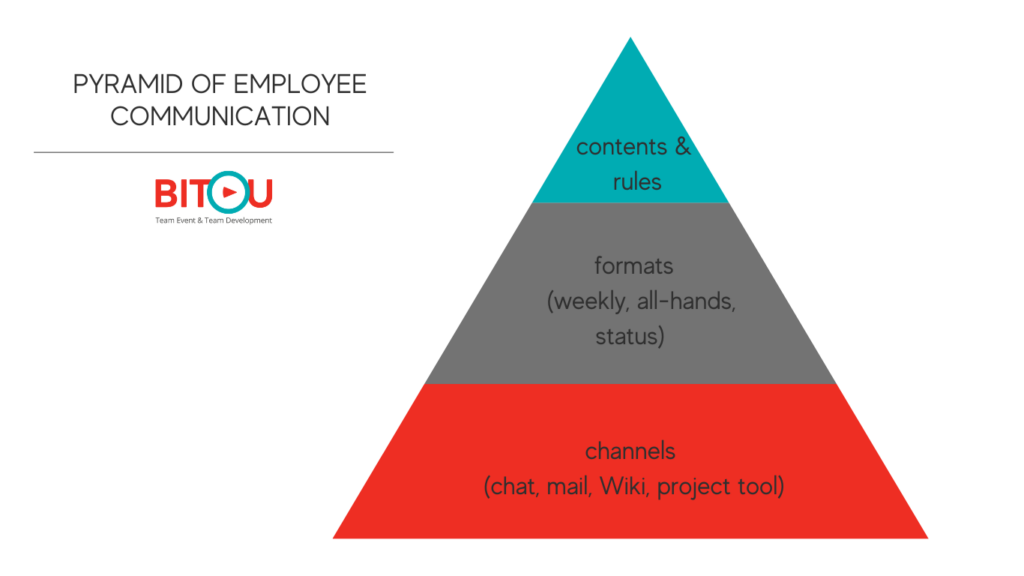
- Clearly define channels: Define what each channel is used for (e.g., chat for voting, wiki for decisions, project tool for status). This way, employees know where to find important information.
- Introduce regular update formats: Short routines such as a weekly (10 min.) or monthly all-hands meeting ensure that information arrives in a planned manner – rather than only “when there’s an emergency.”
- Create a central information hub: A wiki or intranet as a “single source of truth” makes decisions, priorities, and processes permanently accessible.
- Define responsibilities: Clarify who communicates updates (e.g., executives, project management, HR). Without clear responsibilities, gaps can quickly arise.
- Reducing information overload: Prioritize content (“need-to-know” vs. “nice-to-know”), work with short summaries, and rely on a collective update rather than many individual messages.
This creates employee communication that works reliably and provides the team with guidance at all times.
Employee communication in hybrid teams (remote & shift work)
In hybrid teams, employee communication must be organized in such a way that information is accessible to everyone—regardless of location or working hours. The following are particularly important in this regard:
- Asynchronous instead of just in chat: Document important information (e.g., wiki/intranet) so that it can be found later.
- Briefly record meetings: Share decisions and to-dos as a summary so that no one misses any information.
- Secure shift handovers: Use a handover logbook or digital bulletin board so that each shift starts from the same point.
This keeps the team informed without presence or chance deciding.
Conclusion
Good employee communication does not come about by sending out more information. Clear structures, reliable routines, and a central location where information is permanently accessible are crucial. When channels are used clearly, updates are provided regularly, and knowledge is documented, the team remains on the same page. This reduces misunderstandings, saves time, and strengthens cooperation and trust. Companies that systematically set up employee communication create a stable foundation for efficient work—regardless of whether teams work on-site, hybrid, or in shifts.
| Pia Neugebauer
About the author

Pia Neugebauer is the managing director and head of human resources at BITOU GmbH and brings with her many years of experience in human resources management and leadership styles.
With a keen sense for interpersonal dynamics and a great deal of enthusiasm for sustainable change processes, she regularly writes about topics that really help teams move forward.
You can find out more about Pia and her current projects here.
You may also be interested in

Agile thinking as the core of modern leadership intelligence
Accepting ambiguity and using it productively is not purely a question of attitude. It is a skill that can be developed and is a central component of modern leadership intelligence. In a world that is increasingly volatile, complex, and interconnected, leadership intelligence is becoming a decisive factor for success.

Energizer Games: How to Boost Engagement in Meetings
Activation games are a real game changer for meetings, as they get rid of the meeting grump from both sides: The participants are motivated again and the moderator gets an attentive audience again – a win-win situation.

How do you combine getting to know each other with company identification?
A team event for the international Deutsche Post team. The aim is for the employees to get to know each other better and at the same time for the new team members to experience the corporate culture and develop a stronger identification with the company.