

From base camp to encounter: Why a council can be the right follow-up to “Adventure Everest”

Review: Six months after the “Adventure Everest”
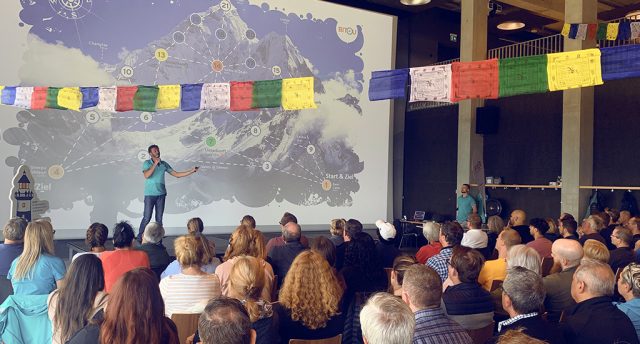
Six months ago, a team of around 20 employees from two different departments at a Swiss company embarked on an unusual journey: as part of the “Adventure Everest” team development program, they had to climb a symbolic mountain together as a rope team. The module not only offered an exciting simulation, but also acted as a mirror: it clearly showed that the team lacked a common direction, mutual understanding, and fundamental trust.
Now, six months later, the question arises: what next? How can this team build on this experience in a meaningful way and take up new ideas without falling back into old patterns?
The key question: How will the journey continue?
Now, six months later, the question arises: What happens next? How can this team build on its achievements and seize new opportunities without falling back into old patterns?
The search for a suitable format
The coach in charge specifically sought a format that would not only address the team on a professional level, but also appeal to them on an emotional and personal level. Traditional methods or further simulations did not seem appropriate. The idea was to create a space for genuine, open exchange. Something unexpected. Something that creates space rather than imposing structure. This led to the decision to form a council.
What defines a business council
A business council is more than just a discussion group. It is a deliberately slow-paced, ritualized circle in which people say what they want to say—without judgment, without reaction, without discussion, with a leader who provides structure, calm, and neutrality. Whoever holds the talking stone (or another symbol) speaks. Everyone else listens—really listens.
Especially in a team that is characterized by a high degree of personal responsibility, innovative spirit (e.g., education without grades), and a certain degree of individuality, the Council creates a framework in which new connections can be formed.
The Council’s goal: Encounter instead of problem solving
In this case, it wasn’t about planning or solving problems. The goal was to experience being a team again, build trust, and talk about issues that often remain beneath the surface.
Why the Council was the ideal continuation
The Council, as a continuation of “Adventure Everest,” was therefore a wonderful follow-up and a source of inspiration, as well as a change of perspective for everyone involved.
Away from doing – toward listening.
Away from the goal – toward encounter.
And sometimes that is precisely the most important next step.
|Marcus Richter
About the author

Marcus Richter is a moderator and team trainer at BITOU Süd GmbH and has many years of experience in the field of team development, including psychological safety and team performance.
With a keen sense for interpersonal dynamics and a great deal of enthusiasm for sustainable change processes, he regularly writes about topics that really help teams move forward.
You can find out more about Marcus and his current projects here.
You may also be interested in
How “Adventure Everest” became “Adventure Crap Sogn Gion”
Strategic team building at 2700m: How the simulated climb to Mount Everest against an impressive backdrop anchored the shared vision and core corporate values in the team.

Change Management – How we support you with change processes in your company
The implementation of new processes and structures requires a team culture in which change can be lived, but also openness and a certain degree of curiosity, flexibility and vitality.

Management vs. leadership – how to train leadership and management skills in a team
Leadership spearheads new visions and initiatives, while management effectively controls the resources to turn those visions into reality.