Communication Workshop

Communication is essential for a team, as it facilitates the exchange of ideas and information, thereby helping to avoid misunderstandings and clearly define shared goals. Open and transparent communication builds trust, which strengthens collaboration and team spirit. Furthermore, effective communication promotes the swift and efficient resolution of problems, as all team members can contribute their perspectives and work together to develop solutions.

BITOU Communication Workshop Programme

Introduction: Building knowledge and understanding

Experience an inspiring start to our Communication Workshop at BITOU, where we teach the fundamentals and background of communication. With engaging theoretical content such as the sender-receiver model, the power of verbal and non-verbal communication, and overcoming typical communication barriers, we lay a solid foundation for your teamwork.

Active Module: Bringing Communication to Life

Immerse yourself in our unique active module, where theory meets practice! Through interactive exercises and engaging games, participants apply what they have learnt straight away. The Adventure Everest module, for example, strengthens communication among participants – including across teams – by working towards shared goals. Experience how active listening, constructive feedback and effective team communication are put into practice in real-life scenarios. Our experience-based activities ensure that communication skills are not only understood, but also felt and put into practice.

Reflection and application: sustainability in everyday working life

The intensive practical phases are followed by a joint reflection session. Here, participants reflect on their experiences and discuss how they can integrate their newly acquired communication skills into their everyday working lives. This application phase ensures that what has been learnt has a lasting impact and that team communication is improved in the long term.

The benefits of BITOU: experience, expertise and a unique approach

With BITOU, you benefit from years of experience and highly qualified trainers, such as Marcus Richter, who design their workshops with specialist knowledge and teaching expertise. Our unique BITOU concept brings theoretical content to life through hands-on activities, ensuring lasting learning success. Discover how communication strengthens your team and leads you to new heights together!

Seize the opportunity to revolutionise communication within your team and experience a workshop that turns theory into practice and delivers lasting results. Be inspired by BITOU and take the first step towards more effective and harmonious team communication!

Communication – The be-all and end-all for your team

Teamentwicklung Beratung

Why it is important to understand the fundamentals of communication

Effective communication is at the heart of any successful collaboration. However, to communicate truly effectively, it is crucial to understand the background and fundamental principles of communication. This understanding enables us to avoid misunderstandings, communicate more clearly and build better relationships in both professional and personal contexts.

The basic principles of communication

Communication is not just about exchanging information; it also encompasses the way in which this information is conveyed and received. The basic principles of communication include:

Verbal and non-verbal: Communication takes place through both words and body language, facial expressions and gestures. A large proportion of our messages is conveyed non-verbally, which is why it is important to be aware of one’s own body language and to interpret others’ signals correctly.
Context and environment: The situation in which communication takes place has a significant influence on the message. The context determines how messages are perceived and understood.
Active listening: Effective communication requires not only sending messages, but also active listening. This means giving the person you are talking to your full attention and truly understanding their message.

Teamentwicklung Workshop
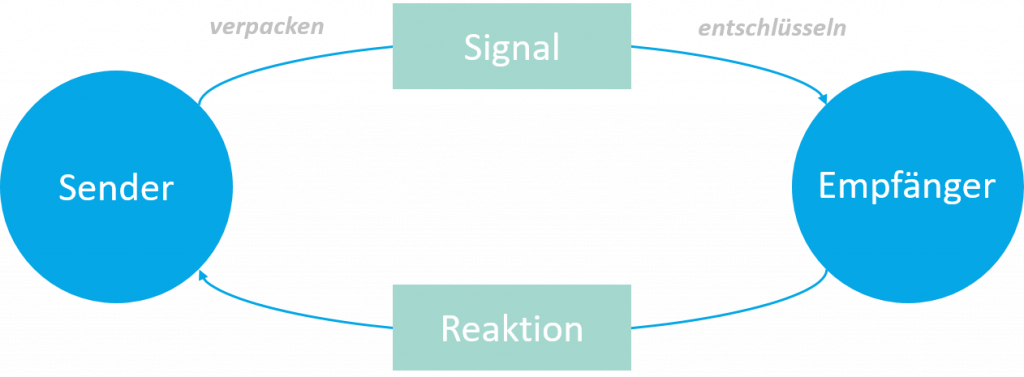
Sender Empfaenger Modell 1024x377 1

The sender-receiver model

The sender-receiver model is a simple yet powerful tool for understanding the dynamics of communication. It describes the process of transmitting messages between a sender and a receiver:

Sender: The sender is the person who transmits a message. The sender must encode the message clearly and comprehensibly to ensure that it is correctly understood by the receiver.
Message: The actual information being transmitted. This can be verbal or non-verbal and is always shaped by the context of the situation.
Channel: The channel is the medium through which the message is transmitted, e.g. verbal communication, written messages, emails or gestures.
Recipient: The recipient is the person who receives and decodes the message. The recipient must interpret the message and respond to it.

The importance of understanding

By understanding the fundamental principles of communication and models such as the sender-receiver model, we can significantly improve our communication skills. We learn to formulate our messages clearly and precisely, to better understand the needs and perspectives of those we are speaking to, and to respond appropriately to misunderstandings. This knowledge is essential for conducting effective and productive conversations and building strong relationships.

In summary, understanding the fundamentals of communication not only provides theoretical knowledge but also strengthens practical skills that are essential for success in our daily interactions

Teamentwicklung klein 10

Experience communication – BITOU activity modules

On thin ICE - the core of teamwork
5 – 500
150 – 240 min
Face to Face

On thin ICE – the core of teamwork

Teams today face considerable challenges and often have to navigate on thin ice. In the team building simulation On thin ICE (by Tirian), effective communication and coordination are of central importance. It is essential that teams actively share information and cooperate closely in order to …

Applying what has been learnt to everyday working life

The importance of applying what has been learnt to everyday working life

Applying what has been learnt in the workshop to everyday working life is crucial to ensuring and maximising the positive effects in the long term. When employees actively put their newly acquired communication skills into practice, both they themselves and the overall working atmosphere benefit.

Benefits for employees and the working environment

Improved collaboration: Clear and effective communication reduces misunderstandings and makes teamwork more harmonious and productive.

Greater trust: Open and transparent communication fosters trust among colleagues, leading to greater cohesion and a positive working environment.

Efficient problem-solving: With the right communication tools, conflicts can be resolved more quickly and constructively, which improves the overall working atmosphere and reduces stress.

Personal development: Employees who can communicate effectively feel more competent and confident in their roles, which increases their motivation and satisfaction.

By ensuring that what has been learnt is applied in the day-to-day workplace, we create a lasting improvement in the communication culture, which contributes to a positive and productive working environment in the long term.

The knowledge and skills taught in our communication workshop at BITOU can be seamlessly integrated into everyday working life. Thanks to the experiential methods and direct application in the practical module, what has been learnt is firmly embedded. Through interactive exercises and real-life scenarios, participants experience first-hand how effective communication works and what a difference it makes.

Our experienced trainers at BITOU provide participants with valuable, practical tips on how to continue using and developing their newly acquired communication skills in their day-to-day working lives. These tips help participants to internalise what they have learnt in the long term and apply it in their daily collaboration. In this way, effective and clear communication becomes a habit that strengthens teamwork and promotes professional success.