Psychological safety in the workplace is essential because it creates an environment in which employees can take risks, ask questions and openly admit mistakes without fear of negative consequences. This not only fosters innovation and creativity, but also strengthens teamwork. In such a supportive atmosphere, employees feel valued and encouraged to give their best. The result is a more productive and harmonious working environment in which employee satisfaction and engagement increase. Psychological safety enables everyone to realise their full potential and contributes significantly to a healthy and dynamic working atmosphere.
The workshop begins with a comprehensive introduction to the concept of psychological safety. Our experienced and qualified trainers, drawing on in-depth specialist knowledge and years of practical experience, provide participants with the essential theoretical foundations. Through engaging presentations and interactive discussion sessions, a deep understanding is fostered of why psychological safety in the workplace is of crucial importance. Participants learn how to create an environment in which employees can take risks, ask questions and openly admit mistakes without fear of negative consequences. This forms the basis for innovation, creativity and effective teamwork.
The second part of the workshop focuses on the practical application of the knowledge acquired. BITOU has developed a unique concept for this purpose, which aims not only to convey psychological safety in theory, but also to make it a tangible experience. Through specially designed exercises that simulate real-life work situations, participants can actively practise and experience the principles of psychological safety. These practical exercises enable participants to try out and internalise the theoretical content within a safe environment. The active modules promote an understanding of how psychological safety can be implemented in day-to-day work practices and what positive effects this has on the team and the work culture.
The workshop concludes with an in-depth reflection session, during which participants reflect on and analyse their experiences from the interactive modules. Together, they explore how they can integrate what they have learnt into their everyday working lives. Our trainers support participants in developing individual strategies and measures to embed psychological safety sustainably within the corporate culture. This includes specific recommendations for action and practical tips that facilitate the transfer of what has been learnt into everyday working life. This structured reflection ensures that participants not only understand the principles of psychological safety, but are also able to apply them successfully in their daily work.
BITOU stands out thanks to its many years of experience in delivering workshops and training courses, as well as the dedication of our highly qualified trainers. Our tried-and-tested approach ensures that psychological safety is not only understood in theory, but also experienced in practice and implemented in a sustainable manner. BITOU’s practical approach enables participants to apply the workshop content directly and integrate it into their day-to-day work. This leads to a noticeable improvement in the working atmosphere, stronger teamwork, and higher employee satisfaction and productivity.
Experience with BITOU how psychological safety becomes an integral part of your corporate culture. Benefit from our in-depth knowledge and practical approach, which enables you to create a working environment in which your employees can realise their full potential. BITOU stands for high-quality workshops that have a lasting impact and deliver measurable results.

Psychological safety refers to a working environment in which employees can express their opinions, ask questions, put forward ideas and admit to mistakes without fear of negative consequences. This sense of safety creates an atmosphere of trust and openness within the team, thereby fostering innovation and creativity.
In day-to-day work, psychological safety manifests itself through improved collaboration, greater commitment and increased employee satisfaction. Employees feel encouraged to contribute fully and actively contribute to the team’s success. This fosters a positive corporate culture in which everyone can realise their full potential.
Ultimately, psychological safety leads to higher productivity and greater business success. Employees who can openly share their ideas and concerns contribute to problem-solving and the development of new strategies. This strengthens both the individual growth of employees and the competitiveness of the company.
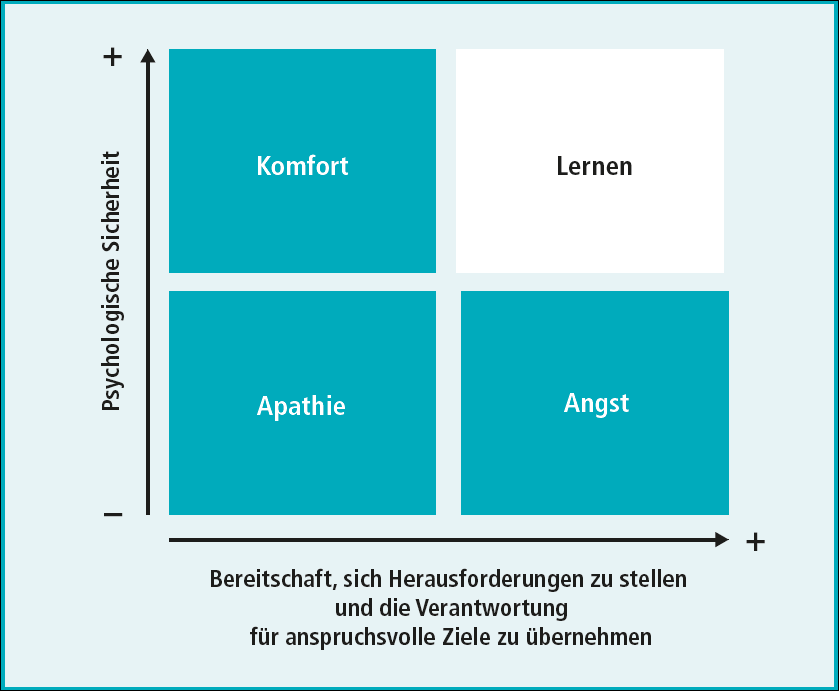
Psychological safety is influenced by several factors, including leadership culture, communication styles and behaviour within the team. When leaders encourage open feedback and view mistakes as opportunities to learn, they create an environment in which employees feel safe to step outside their comfort zone. This sense of security enables them to develop new ideas, take risks and find innovative solutions. In such an environment, employees grow both personally and professionally, as they are able to continuously learn new skills and build on their strengths. Establishing psychological safety therefore not only promotes individual progress but also strengthens the entire organisation.


Without psychological safety, employees are often apathetic and rarely step outside their comfort zone. They avoid putting forward new ideas or taking risks for fear of negative consequences. This leads to a stagnant working environment in which innovation and creativity are stifled, thereby reducing efficiency and productivity.
In a working world characterised by constant change and increasing complexity, fear can significantly hinder progress. Employees who do not feel secure hold back, which delays projects and exacerbates problems.
Managers must actively create a safe and open working environment. Investment in workshops and team-building activities is crucial to establishing and fostering psychological safety. These measures help to alleviate fears and strengthen the team’s ability to collaborate and innovate.
Companies that invest in psychological safety not only create a more productive working environment, but also a culture in which innovation and collaboration flourish. Psychological safety means that employees can express their opinions, ask questions and admit mistakes without fear of negative consequences. This leads to open communication, creative ideas and faster problem-solving.
Employees who feel secure are happier, more committed and more loyal – they stay with the company longer and actively contribute to its success. By promoting psychological safety, you are investing in your company’s future: you reduce staff turnover, boost productivity and build a motivated, dynamic team that achieves great things together. Take the step towards becoming an innovative and strong company by creating a working environment in which every employee can realise their full potential.

Applying the insights gained from a workshop on psychological safety to everyday working life is a crucial factor in the workshop’s long-term success. Only through effective application can participants integrate what they have learnt into their working environment in a sustainable way and establish a culture of psychological safety.
Applying what has been learnt to everyday working life is essential to ensure that the concepts and techniques taught in the workshop are not only understood in theory but also put into practice. This contributes to the sustainability of the learning process by enabling participants to consolidate and further develop the skills they have learnt. Without effective transfer, there is a risk that the knowledge will be quickly forgotten and the workshop will have no lasting impact.
A successful transfer facilitates the integration of psychological safety concepts into daily work routines. This means that participants are able to apply what they have learnt in real-life work situations, whether it be giving and receiving feedback, conducting difficult conversations, or fostering a culture of open and trusting communication. Integration into everyday working life is crucial to ensuring the continuous improvement and adaptation of working practices.
The workshop’s practical module plays a key role in knowledge transfer by enabling participants to apply what they have learnt in a controlled environment. Through a module such as our Deep Sea Expedition, participants can test their skills in a safe setting and learn more about themselves and their colleagues. This practical application promotes understanding and confidence in one’s own abilities, which facilitates the transfer of skills into real-life working situations.
An experienced trainer, such as Britta Beste, is also crucial to successful knowledge transfer. The trainer not only brings in-depth knowledge and practical experience to the table, but is also able to respond individually to the needs and challenges of the participants. Through tailored advice and ongoing support, the trainer helps participants apply and further develop what they have learnt in their specific work situations. This support can take the form of follow-up sessions, one-to-one coaching and additional resources.
Applying what has been learnt in the workshop to everyday working life is crucial to the workshop’s success. It ensures that participants not only understand the concepts of psychological safety in theory, but can also apply them in practice and integrate them into their daily working routines. The measures taken and the support provided by an experienced trainer are key elements in this process,, facilitating the transfer and ensuring the sustainability of learning. Only through effective transfer can participants successfully establish and promote a culture of psychological safety in their working environment.