
Demonstrating the impact of team-building events
Anyone who budgets for, facilitates or defends a team-based initiative internally is often familiar with the critical question even before it begins: what will this actually achieve in the end? This is precisely where the issue of demonstrating the impact of team events becomes relevant. Not as a formal formality, but as a prerequisite for ensuring that team development within the organisation is taken seriously, properly structured and sustained.
A successful event often generates a palpable sense of energy. The atmosphere improves, conversations become more open, and tensions ease, at least to some extent. The problem usually only arises afterwards. If the impact is described solely in terms of gut feeling, it remains open to criticism during budget discussions. On the other hand, anyone who can demonstrate what has actually changed within the team will gain the support of management, HR and senior leadership, and turn a single event into a genuine step forward.
Which formats we use for this and how the evaluation works is set out on our page on team building for companies.
Why demonstrating the impact of team-building events is more than just measuring success
Many companies still equate team events with motivation, a change of pace or recognition. Whilst this is not wrong, it does not go far enough. As soon as teams are faced with friction, silo mentality, unclear roles or pressure to change, a positive experience alone is not enough. What matters then is collaboration, trust, communication and performance in day-to-day work.
Anyone wishing to demonstrate the impact of team-building events should therefore first clarify exactly what kind of impact is being referred to. Is it about short-term motivation, a stronger sense of unity, better coordination in day-to-day project work, or addressing specific conflict patterns? The clearer the answer to this question, the fairer and more robust the subsequent evaluation will be.
Measurability also helps to avoid a common misconception: not every team problem can be resolved in half a day. A team event can provide an important impetus, but it is no substitute for leadership, structure or long-term development work. It is precisely this distinction that lends credibility to the assessment.
Without a clear objective, it is impossible to demonstrate any impact
The most common mistake lies not in the evaluation, but in the lack of a clear mandate. If the sole aim is simply for the team to do something together again, the impact will remain vague. In that case, at best, satisfaction and morale can be measured, but no tangible change in the way the team works together.
It is better to set two to four specific objectives in advance. For example: improving cross-departmental collaboration, increasing psychological safety, reflecting on communication patterns, or clarifying roles following a reorganisation. These objectives do not need to be formulated in academic terms. What is crucial is that they are observable.
For HR and management, this means: don’t start by discussing the format, but rather the team situation. Where are the current sticking points in collaboration? How do employees notice in their day-to-day work that something isn’t running smoothly? And how would you be able to tell, once the format has been implemented, that things have improved? That is precisely where proper impact measurement begins.
What can be usefully measured at team events
Not everything that matters in teams is immediately reflected in hard metrics. Nevertheless, far more is measurable than many people realise. When it comes to team-related initiatives in particular, it is worth distinguishing between three levels: reaction, changes in team behaviour, and transfer into everyday practice.
The first level is the immediate response. How suitable was the format? Were issues addressed openly? Did those involved feel they were taken seriously? This data is helpful, but it does not yet demonstrate the actual impact.
The second level is where things get more interesting. This level focuses on changes in factors such as trust, coordination, a culture of feedback, clarity of expectations and a willingness to collaborate. Such aspects can be assessed very effectively through short ‘before and after’ surveys, team checks or structured self-assessments.
The third level is often the most important for decision-makers. What evidence of this becomes apparent a few weeks later in day-to-day working life? Are meetings more focused? Do misunderstandings escalate less often? Do teams working across different departments collaborate more constructively? Are decisions implemented more clearly? It is at this point that a positive experience becomes a meaningful contribution to the organisation.
Demonstrating the impact of team-building events using a simple measurement design
You don’t need a complex evaluation project to produce reliable results. In practice, a streamlined measurement design usually works better because it is actually implemented in day-to-day business operations.
It all starts with a brief preliminary assessment. This assesses the team’s current state using a small number of relevant criteria. These might include, for example, trust within the team, clarity in collaboration, conflict management skills, motivation or the perceived willingness to take on responsibility. It is important that the questions are directly relevant to the objectives.
The format is not immediately followed by a simple survey of participants’ feelings, but rather by an initial assessment of its impact. How has the participants’ experience changed? What insights have emerged? What agreements have been reached? This reveals whether the format was not only well-received, but also provided impetus for development.
A second measurement is recommended after four to twelve weeks. It is only at this stage that it becomes clear what has been effective. Changes can be illustrated as the difference between the before and after figures. It is precisely this trend that is often more convincing to internal stakeholders than individual figures taken out of context.
Qualitative observations are also useful. A manager might, for example, describe whether meetings are more structured, whether decisions are reached more quickly, or whether tensions are addressed more openly. Figures and observations together provide the most realistic picture.
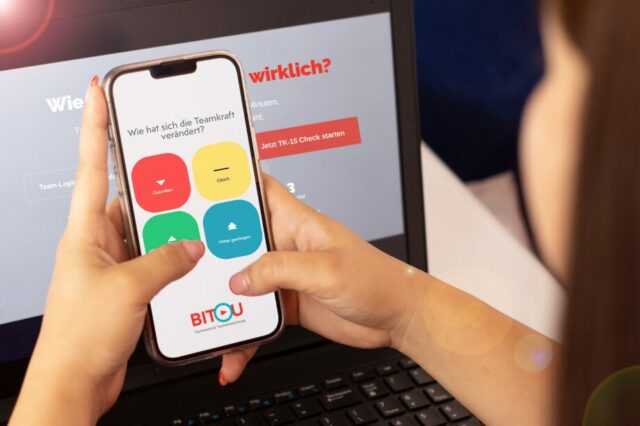
Structured team reviews can be particularly useful for this sort of streamlined approach to measurement. Among other things, BITOU uses the team power, to highlight developments relating to collaboration, energy and team performance. Depending on the format, this can be done via questionnaires before and after the event, a short survey completed on the spot using a tablet, or via the self-assessment on the website.
MAKE THE RIGHT START NOW
Impact starts with measurement.
Before choosing the right level – do you already know where your team and your leaders truly stand today? Both checks are free, anonymous and done in under 10 minutes.
Which key performance indicators are truly useful for HR and leadership?
Many teams get bogged down in too many indicators when measuring success. It is better to use a few key metrics that are clearly relevant to the team’s situation. For an onboarding team, these criteria may differ from those for a management team following a reorganisation.
Key performance indicators that are team-focused and adaptable are usually helpful: perceived quality of communication, trust between roles, participation in meetings, clarity regarding responsibilities, motivation within the team, and willingness to cooperate across departmental boundaries. In some cases, operational data can also be included, such as staff turnover, sickness absence, frequency of escalations or project retrospectives. However, these metrics should never be attributed solely to a team event. There are simply too many factors at play within the organisation for that.
This is precisely where a sense of proportion is important. Anyone who promises too much leaves themselves open to criticism. By contrast, anyone who makes a clear distinction between directly observable team performance and long-term business effects makes a much stronger case.
Why simple satisfaction surveys fall short
The classic question of whether the participants enjoyed it is quickly asked and often of little value. A team may find a day’s session enjoyable without it leading to any changes in their day-to-day work. Conversely, an intensive session may be exhausting yet still provide exactly the clarity the team needed.
Impact-oriented evaluation therefore looks deeper. Have any blind spots come to light? Was the team able to identify critical patterns? Have specific working arrangements been put in place? Are there any clear signs that responsibility, dialogue or mutual understanding have increased?
This is particularly crucial in more challenging team set-ups. In such situations, impact is rarely synonymous with a cheerful atmosphere. Sometimes it first manifests itself in greater openness, a better ability to handle friction, and clearer discussions.
What strengthens and what weakens the validity of measurements
Impact assessment is only meaningful if it remains closely aligned with the team’s reality. This starts with clear questions, continues with appropriate timing, and ends with an honest interpretation of the results. A questionnaire with twenty abstract dimensions may look professional, but it often yields fewer than five precise insights into actual collaboration.
The validity of the findings is undermined if the objective, format and evaluation do not align. A casual summer event can hardly serve as evidence of sustainable conflict resolution. A one-day team-building session can provide impetus for trust and communication, but cannot definitively resolve deep-seated role conflicts. It is precisely this context that builds trust in the results.
That is why it makes sense to view team events not in isolation, but as part of a development process. Experience-based formats, thoughtful reflection, diagnostic assessments and the application of these insights to everyday life work best when integrated with one another. Providers such as BITOU focus precisely on this intersection of team dynamics, structure and measurable change.
How a team event can become a lasting catalyst for development
If companies want to demonstrate the impact of team-building events, they don’t need complicated methodology – they need clarity. What is the aim? How can this be recognised? When will it be assessed? And what does this mean for the team’s day-to-day work?
The best impact assessment doesn’t end with a report. It provides a basis for discussion amongst managers, guidance for HR and, above all, a concrete next step for the team. That is precisely where the real value lies: when shared experience leads to shared development.
Anyone who plans, measures and follows up on team events in this way won’t need to gloss over their benefits later on. They can demonstrate them.

You might also be interested in
Team Power: the new benchmark for success
Teamkraft is more than just a tool for analysing collaboration. Teamkraft combines measurable data with the human aspect of teamwork and corporate culture. It lays the foundation for honest dialogue, targeted development and long-term business success.

Planning company parties: Tips for unforgettable events
Whether it’s a festive Christmas party or a summer team event, a successful company party thrives on a clear structure, a varied programme and a harmonious setting. This article highlights the key elements for a successful event – and how they can have a lasting impact on the company.