

Staff development tools: How to nurture talent

Have you ever wondered whether there are hidden superpowers lying dormant in your team? The answer is almost always: yes. Many employees use only a fraction of their actual talents in their day-to-day work because the right conditions or tools are lacking.
For managers, staff development is no longer just a ‘nice-to-have’ but a crucial factor for success. By actively nurturing talent, you retain staff and boost the performance of the whole team.
But how do you bring out this potential? Here is a practical guide on how to identify and nurture talent, and deploy it strategically to ensure the team’s success.
A 3-step guide for managers: nurturing talent in everyday life
Effective staff development doesn’t just happen once a year during the performance review. It is an ongoing process.
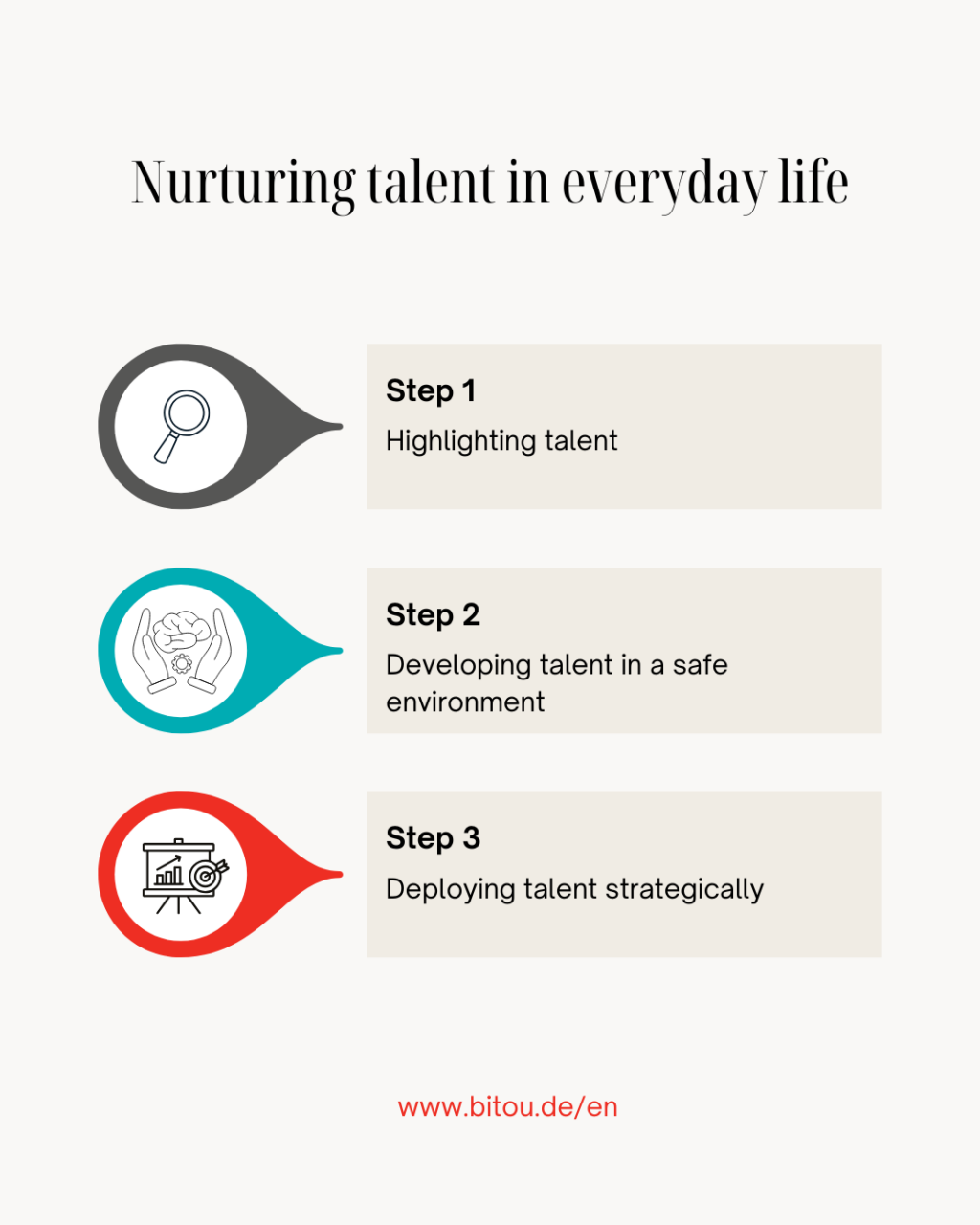
1. Uncovering talents (The treasure hunt)
Before you can support someone, you need to know where the journey is heading. In your day-to-day life, keep an eye on two things:
Energy rather than just performance: where does an employee really thrive? Tasks that come easily to us and give us energy (rather than simply draining it) are a direct indication of a talent.
The direct conversation: Ask straight out: “Which tasks last week made you completely lose track of time?”
2. Providing a safe space (The trial run)
A talent is like a muscle – it needs to be exercised. Give your staff the chance to try their hand at new areas without the success of the entire quarter being directly dependent on it. Make a conscious effort to delegate smaller sub-projects that lie outside their core areas of expertise.
3. Using it strategically (The Puzzle Principle)
Forget rigid job descriptions. If you notice that someone in the team has a real knack for strategic planning but is actually working in support, reallocate their tasks. This method is called ‘job crafting’, where the role is adapted to the person’s strengths – not the other way round.
Innovative modules: Unleashing potential through play
Traditional seminars often reach their limits when it comes to uncovering genuine behavioural patterns and hidden strengths. This is where interactive and experience-based modules come into their own. Here are two excellent examples of how you can foster talent within your team in a fun and effective way:
Module 1: The Deep-Sea Expedition – Bringing Strengths to Light
It is under pressure and in unfamiliar situations that people reveal their true colours – and their true strengths. The module Deep Sea Expedition simulates a journey into uncharted waters.
How it works: The team is faced with a complex challenge that can only be solved through cooperation and lightning-fast thinking.
The impact on staff development: In this scenario, hidden talents almost automatically come to the fore. Who takes charge of maintaining structure during a crisis? Who keeps their emotional composure? Who comes up with the most creative solution? It reveals the ‘treasures’ within your team that often remain hidden in day-to-day office life.
Module 2: The Cake Factory – Perfect Roll Matching
In many teams, not everyone is in the ideal role. The Cake Factory module breaks down these structures.
How it works: In a simulated ‘bakery’, participants take on a wide variety of roles – from the detail-oriented quality controller to the stress-resistant production manager and the quick-footed waiter. Throughout the process, they rotate between roles and try them out. At the end of the module, the team reflects together: who performed best in which role?
The impact on staff development: the end result is a structure in which everyone takes on the role that works best for the team as a whole. It takes the pressure off ‘real’ day-to-day work and shows, in black and white, just how efficiently the team works when roles are perfectly allocated according to talent.
Conclusion: Nurturing talent means reaping the rewards
Supporting staff is not an act of charity, but a modern management practice. By using formats such as the deep-sea expedition or the Cake Factory, you not only create highlights for your team events, but also gain valuable insights for your strategic HR planning.
A leadership tip to take away: Take a close look this week. Which talent in your team is just waiting to be discovered and nurtured by you?
What tools do you already use in your team to highlight talent?

You might also be interested in

The Power of Integration—How Companies Shape Transformation from Within
Employee engagement is the driving force behind business success. Those who manage to truly engage their employees lay the foundation for profound cultural change and sustainable growth. Excellent service does not come about solely through friendly front-line staff—it comes about when every step of the process is conceived and designed with the customer in mind.

Conflict Resolution in Teams: Strengthen Collaboration and Productivity
Conflicts in a team cannot be completely prevented. But a team can learn to solve them in time before the team spirit or even process flows are endangered.

Leadership that fosters growth—Why true greatness lies in the success of others
Leadership is changing, just like today’s working world. Whereas authority, control, and expertise often set the tone in the past, other things are now at the forefront: serving the team and the task of developing potential rather than suppressing it.