

Critical thinking in the age of AI: Are we becoming mere passengers in our own minds?

If our main role in the future is simply to review the results produced by AI, then we are not securing our future – we are making ourselves replaceable in the long run.
For years, researchers, consultants and executives have been observing a gradual decline in independent thinking. Long before generative AI became part of everyday life, a growing problem was becoming apparent in companies: people are relying increasingly on systems, processes and ready-made answers – and less and less on critical thinking.
With the rise of artificial intelligence, this development is now entering a new phase.
Why critical thinking is becoming more important in the age of AI
Today, AI can write texts, create presentations, generate images and summarise complex analyses in a matter of seconds. Yet that is precisely where the danger lies.
For whilst artificial intelligence offers speed and efficiency, it lacks genuine accountability, sound judgement and an understanding of context.
That is precisely why critical thinking is becoming one of the most important skills of the future in the age of AI.
Those who do nothing but consume lose the ability to question.
Those who do nothing but validate lose the ability to create.
The silent danger: outsourced thinking
Our brains love convenience. AI provides the perfect shortcut: quick answers, ready-made phrases and seemingly intelligent solutions.
But just as sat-navs can dull our sense of direction, excessive use of AI also alters our ability to think in the long term.
More and more people are falling into a form of ‘cognitive offloading’ – that is, the habit of outsourcing mental work to systems.
The consequences of this are subtle but serious:
- less analytical thinking
- lower problem-solving skills
- declining creativity
- impaired judgement
- more superficial decisions
This is becoming increasingly apparent, particularly in businesses.
AI in business: efficiency over understanding?
In many organisations, productivity is rising rapidly thanks to AI. Tasks are completed more quickly, content is produced more efficiently, and decisions are made on the basis of data.
But at the same time, a dangerous side effect arises:
The findings are increasingly being adopted without really being properly understood.
Managers often present standard solutions that address short-term symptoms – but fail to identify the root causes or underlying tensions behind a problem.
The problem here is not a lack of intelligence.
The problem is a lack of intellectual depth.
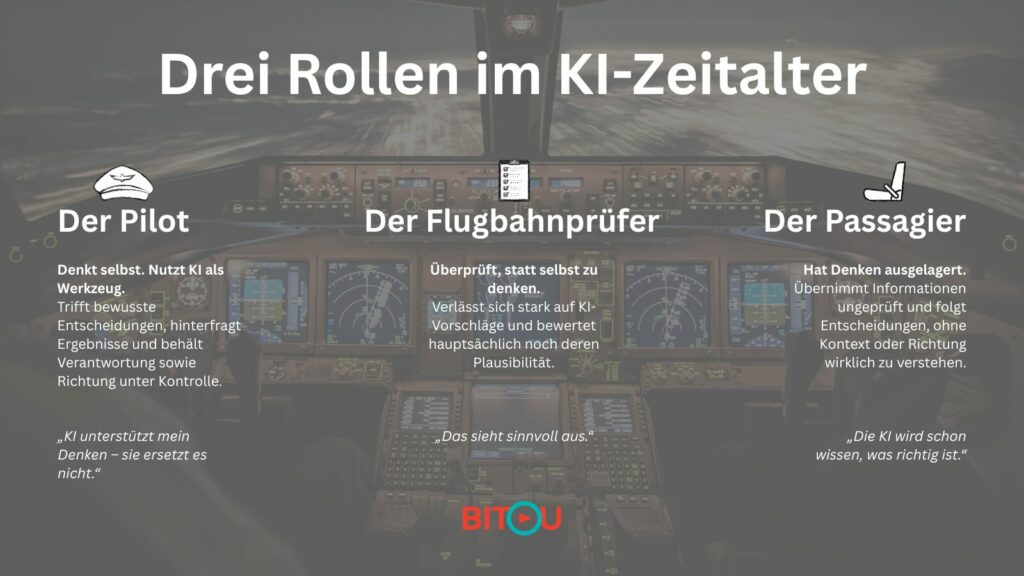
From pilot to passenger
Microsoft researcher Advait Sarkar aptly describes our current situation:
We are becoming ‘intellectual tourists’ in our own work.
Ideas are increasingly being consumed solely through AI-generated summaries, rather than being developed, questioned and thought through by individuals themselves.
This also changes our role.
Previously:
We were the masters of our own thoughts.
Today:
Many people become ballistics experts.
AI provides content, analyses and decisions – and we mainly just check whether they seem plausible.
In the worst-case scenario, we even become mere passengers:
We follow a course that we neither devised ourselves nor truly understand.
How to maintain critical thinking in the face of AI
The solution does not lie in rejecting AI.
The solution lies in being more mindful of how we use it.
If critical thinking is to be preserved in the age of AI, AI must be used as a tool – not as a substitute for thinking for oneself.
1. AI should provoke debate
AI should not only provide quick answers, but also facilitate counterarguments, shifts in perspective and critical questions.
2. The process must be understood
Speed must not take precedence over understanding. Often, the real value lies in the thought process itself.
3. Personal perspectives remain crucial
If everyone uses the same AI tools with the same prompts, the same ideas will emerge. Originality can only come about through genuine engagement.
4. Control must remain in human hands
AI can provide information – but responsibility, ethics and strategic thinking remain human tasks.
The real key to the future
The key skill of the future is not knowing how to use AI.
The key skill is:
being able to think for oneself despite the presence of AI.
This is because artificial intelligence can recognise patterns, generate content and calculate probabilities.
But it can’t:
- take responsibility
- pass moral judgement
- develop genuine creativity
- fully understand human complexity
That is precisely why critical thinking is becoming a key competitive advantage in the age of AI.
The crucial question
Perhaps the greatest danger posed by AI is not that machines will start to think.
But that humans will stop doing so.
Because, in the end, there is only one key question:
Shall we remain the captains of our own minds –
or are we gradually becoming mere passengers?

Das könnte Sie auch interessieren

The Power of Integration—How Companies Shape Transformation from Within
Employee engagement is the driving force behind business success. Those who manage to truly engage their employees lay the foundation for profound cultural change and sustainable growth. Excellent service does not come about solely through friendly front-line staff—it comes about when every step of the process is conceived and designed with the customer in mind.

AI strategy with substance: How leadership combines speed and safety
AI is transforming entire industries – but success is not determined solely by IT. This article shows why a clear AI strategy is a matter for senior management, how companies balance tradition and innovation, and what we can learn from examples such as China and JPMorgan.
Can AI become a team member?
It is obvious that AI is reliable and cooperative; after all, these systems were developed to reliably fulfil orders. However, the issue of trust in AI by companies and their teams is the subject of much debate.