

Measure the effectiveness of team-building
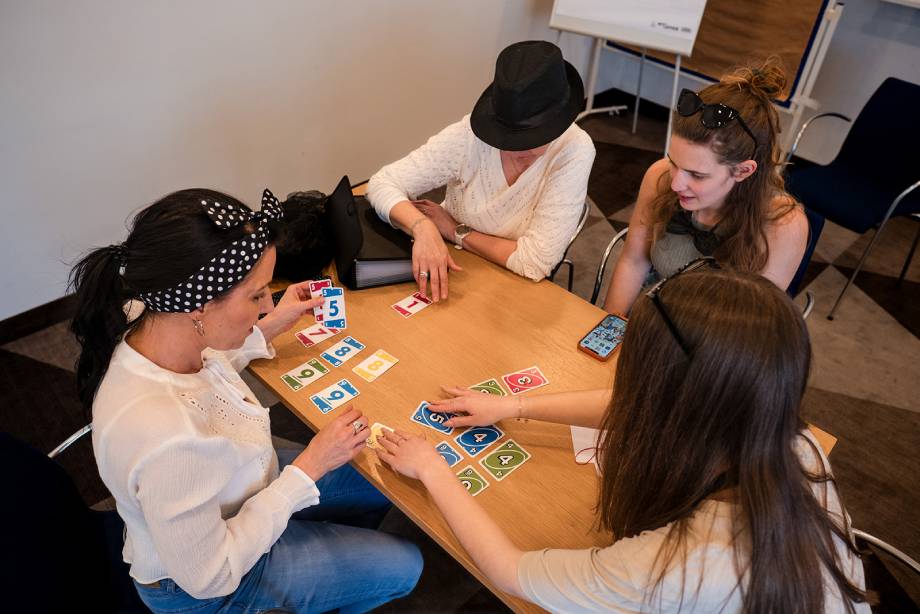
A team-building day was entertaining, the atmosphere was good, everyone got involved – and yet, three weeks later, everything is back to normal in day-to-day life. It is precisely at this point that the question of how to measure the effectiveness of team-building becomes relevant. For companies that don’t just want to provide a nice boost, but aim to improve collaboration in a targeted way, gut feeling alone is not enough.
Team building is still often judged on the basis of how much people liked it. Was it fun? Was the group motivated? Were there good discussions? That’s not wrong, but it’s short-sighted. Because the impact isn’t just felt in the moment, but above all afterwards: in clearer communication, greater trust, better coordination and a stronger sense of commitment in joint action.
Why measure the effectiveness of team building?
Anyone responsible for budgets, planning off-site events or guiding teams through change needs reliable answers. Not every team faces the same issues, and not every initiative contributes to the same development. That is why measurement is not a control mechanism, but a prerequisite for meaningful decisions.
When you measure the effectiveness of team-building, you gain three key things: clarity on actual needs, evidence of the initiative’s benefits, and a better foundation for the next stage of development. This is particularly relevant when teams are experiencing friction, need to regroup following growth, or require guidance during change processes.
Impact-oriented team building therefore asks a different question than traditional event planning. Not: What goes down well? But rather: What specifically changes collaboration, and how do we recognise this? This shift is crucial. Because a format can inspire emotionally whilst simultaneously missing the mark on the actual team issues.
What exactly should change?
Before key performance indicators are defined, a clear impact goal is needed. Otherwise, any assessment becomes vague. A team does not automatically work better together simply because it has solved a task or shared an experience. The central question is therefore: In what way should the quality of collaboration be different after the team-building exercise than it was before?
In practice, this usually involves five key areas: trust, communication, role clarification, motivation and cross-team commitment. Depending on the situation, conflict management or leadership collaboration may also take centre stage. The crucial point is that you should not try to measure everything at once. A sales team following a reorganisation requires different indicators to a newly formed management team or a department experiencing noticeable tensions between departments.
A good impact objective is specific enough to be observable. Instead of stating that the team should ‘work better together’, it is far more helpful to set a goal such as this: decisions are made more clearly, responsibilities are addressed more openly and meetings are conducted in a more committed manner. Only then can meaningful metrics be derived.
Measuring the effectiveness of team building: before, during and after the initiative
Anyone who wants to assess impact seriously needs more than just a feedback form immediately afterwards. Good measurement considers three points in time.
Before the initiative begins, the focus is on the current state of affairs. How does the team currently experience its collaboration? Where are the friction points, and where are the strengths? Structured short surveys, team assessments, interviews with managers, or a facilitated discussion of expectations within the team itself can help here. This phase alone often delivers initial value, as it brings vague problems into sharp focus.
During the initiative, it becomes clear how the team operates under real-world conditions. Who takes responsibility? How are decisions made? How do those involved deal with uncertainty, pressure or differing perspectives? Particularly in intelligently designed team-building formats, patterns can be observed that would otherwise remain hidden in day-to-day work. Professional interpretation is key here: not every behaviour in an exercise is directly transferable to the job, but it often reveals resilient dynamics.
It is only after the exercise that it becomes clear whether these insights will actually be put into practice. That is why, a few weeks later, it is worth checking again to see what has actually changed. Are roles becoming clearer? Are conflicts being addressed sooner? Is coordination at interfaces improving? This is where the real value lies.
Welche Kennzahlen wirklich sinnvoll sind
Not every impact can be captured in isolation using hard business KPIs. However, this does not mean that team-building is vague or arbitrary. It simply requires the right levels of measurement.
The first level consists of subjective team indicators. These include perceived trust, psychological safety, clarity of goals, commitment to agreements, and satisfaction with collaboration. These factors are not trivial. They are often the direct drivers of performance, speed, and error minimisation.
The second level consists of observable behavioural indicators. Here, things become more concrete: How often are responsibilities clearly defined? How disciplined are meetings? How quickly are tensions addressed? Is information actively shared, or does it remain in silos? Such characteristics can be effectively captured through self-assessment and peer assessment, as well as through follow-up reflections.
The third level concerns operational impacts. Depending on the team, these may include shorter decision-making processes, reduced friction, more stable project progress, fewer escalations or improved onboarding experiences. However, it is important to note that the link is often indirect. Team-building is rarely the sole catalyst, but rather part of a development process. This is precisely why the combination of team perception and behavioural change is so valuable.
Common mistakes in measuring impact
Many companies want to measure impact but start in the wrong place. A typical mistake is confusing satisfaction with impact. If participants rate a format positively, this says little about whether collaboration has actually improved. A good atmosphere can be a door-opener, but it is not the end goal.
Equally problematic is measuring too late or too broadly. If you only ask months later whether the team day was worthwhile, it is mainly impressions that stick. If the questions are too broadly worded, you will get nice comments, but no useful insights.
Another mistake lies in the lack of follow-through after the event. Team-building often generates energy and openness. Without points of transfer, clear agreements and a follow-up, this effect quickly fizzles out. It is not that the format does not work, but rather that the follow-up is missing. This is precisely what distinguishes a one-off experience from an effective development initiative.
How to create a robust measurement framework
A practical measurement framework does not have to be complicated. It just needs to be set up properly. The starting point is always the specific team situation. What is the occasion? How do managers and the team currently recognise that something is not running smoothly? And what behaviour should be demonstrated instead?
Building on this, a small number of relevant indicators are defined. Usually, three to five criteria are sufficient to make progress visible. These should be collected in advance, reflected in the framework, and reviewed again later. A delta analysis is particularly effective: what has changed compared to the starting point, and by how much? This makes development traceable without creating artificial, superficial precision.
In practice, a combination of quantitative and qualitative data proves its worth. Scales provide direction, whilst reflection offers context. If a team improves its trust score, that is helpful. The insight becomes even more valuable when it is also clear which behaviours have changed and why.
This is precisely where the difference lies between event evaluation and genuine development diagnostics. Professionally facilitated team-building not only makes the impact tangible, but also provides a basis for discussion. BITOU therefore uses structured assessments, clearly defined areas of impact and actionable development recommendations in such processes, ensuring that teams do not simply stop at a positive feeling.
When measurement is particularly worthwhile
Not every initiative requires the same level of depth. For a small team-building exercise, a simple before-and-after survey may suffice. However, when larger teams, management groups, sensitive conflicts or strategic changes are involved, impact measurement should be designed to be significantly more precise.
This applies, for example, following mergers, reorganisations, rapid growth or changes in leadership. In such phases, collaboration is rarely just a soft topic. It influences pace, commitment, clarity and the quality of results. Anyone who uses team-building here without defining and reviewing the impact is squandering potential.
Measurability is also a key lever for HR and People & Culture teams. It facilitates internal advocacy, improves the selection of suitable formats, and shows which measures contribute more to motivation, which to role clarification, and which to sustainable team development. Not everything needs to be quantified in euros straight away. But it should be clear what has changed and why.
Ultimately, it’s not about reducing team dynamics to a single figure. It’s about taking development seriously. By measuring the effectiveness of team-building, you lay the foundations for a shared experience to translate into real change in day-to-day life – and for a team to gradually evolve into a more effective ‘WE’.

You might also be interested in
12 team-building activities for businesses
12 effective team-building activities for businesses – from events to team coaching. How to boost collaboration, trust and performance.

Agile thinking as the core of modern leadership intelligence
Accepting ambiguity and using it productively is not purely a question of attitude. It is a skill that can be developed and is a central component of modern leadership intelligence. In a world that is increasingly volatile, complex, and interconnected, leadership intelligence is becoming a decisive factor for success.

9 team-building ideas for companies
9 effective team-building ideas for companies that boost collaboration, trust and motivation – delivering tangible results rather than just a nice social programme.