A kick-off to start the year: How to get your team off to a flying start in January

After the Christmas break, we’re faced with full inboxes, unfinished tasks and the first meetings of the year. Yet the questions that will be crucial for the coming weeks often get left unanswered: What are our priorities for the first quarter? What would we like to change in the way we work together? And who needs support to achieve this?
A kick-off meeting at the start of the year provides an opportunity to address these questions. What form it takes depends on what your team needs at that moment. A quick check-in can help to clarify priorities. A facilitated warm-up gets people talking who rarely cross paths in their day-to-day work. And by working on a shared task, teams can see where their coordination is already working well and where there are issues with handover.
Why January is a good time to make a fresh start together
The start of a new year can make it easier to set new goals. Research refers to this as the ‘fresh start effect’: milestones such as the start of a year, a month or a week can motivate people to tackle personal projects. For teams, January therefore offers a good opportunity to try out a specific change in the way they work together.
Make the plan specific enough that it can be fitted into the coming working week. For example, ‘We want to communicate better’ becomes: ‘Over the next four weeks, we’ll spend 15 minutes on Mondays identifying which tasks are interdependent and where decisions are still outstanding.’ Agree straight away when the team will review whether the new routine is helping.
Three ideas to kick off the year that you can implement within your organisation
1. A 30-minute kick-off with ‘Stop, Start, Continue’
Give everyone five minutes to jot down their thoughts on three questions. Which routine is wasting our time and can be scrapped? What should we try out? What works well and should be kept? Collect the answers and, as a group, choose one change to trial for four weeks. Finally, agree on who will take the first step and when the team will review the results.
2. Progress meetings with a view to the first quarter
Use one-to-one meetings in January to clarify goals and support needs at an early stage. A good opening question is: “What would you like to achieve by the end of March, and what do you need from me or the team to do so?” This can lead to a specific agreement, such as a designated point of contact for a new project or time set aside for further training. Make a note of what both sides will contribute.
3. A learning lunch to encourage discussion within the team
Set aside 30 minutes and ask three people to each share one insight from the past year. This could be a useful template, an improved process or an experience from a project. Allowing three minutes per contribution leaves enough time for questions. Finally, the team selects one idea that they would like to try out in January. This format also works well as a brief digital discussion.
Team-building at the start of the year: Which BITOU formats are best suited to your kick-off event?
A professionally facilitated team event can be a standalone item on the agenda for your annual kick-off. For example, you could organise the main part of the kick-off internally and complement it with a warm-up session to get to know one another, or an active icebreaker before the first working session begins. If you wish to reflect specifically on teamwork, a format involving a group task followed by a brief debrief is ideal.
| What would you like to achieve? | Recommended BITOU activity |
|---|---|
| Help people make new connections |
WUP is a 45- to 60-minute warm-up for groups of 40 or more. Participants work in small teams and tackle challenges that also require them to collaborate with other groups. It works well before a conference or workshop that brings people together from several departments. Explore WUP |
| Get people moving and energised |
At the Haka Event, participants are guided through the movements and vocal elements of a haka, a Māori ceremonial performance. It offers an active start to your New Year kick-off. The session lasts 30 to 60 minutes and is available for groups of 10 or more. Explore the Haka Event |
| See how handovers between teams work |
In Chain Reaction XXL, each team builds one section of a larger chain reaction. The joint test shows whether the timing and handovers between sections work as planned. In the debrief, ask: “Where in our day-to-day work would clearer handovers help us collaborate better?” Explore Chain Reaction XXL |
| Practise communicating under pressure |
In Code Crackers, teams solve puzzles and decipher clues. This indoor escape game shows how the group shares information, divides up tasks and makes decisions when time is tight. Explore Code Crackers |
| Get the team outdoors |
In the Smart Team Challenge, small teams use tablets to explore the area and complete puzzles, photo challenges and video tasks along the way. If you are planning a January event, choose a route and start time that suit the weather and daylight hours. Explore the Smart Team Challenge |
What we should carry forward from the start of the year into our everyday lives
When planning, think about what you want your team to take away from the kick-off. Perhaps you want new colleagues to get to know one another across departmental boundaries. Perhaps you need a clear priority for the first quarter or a smoother handover between two departments. If you agree on a new way of working, book a slot straight away for a brief review. Then you can decide together what to keep and what to adjust.

You might also be interested in this
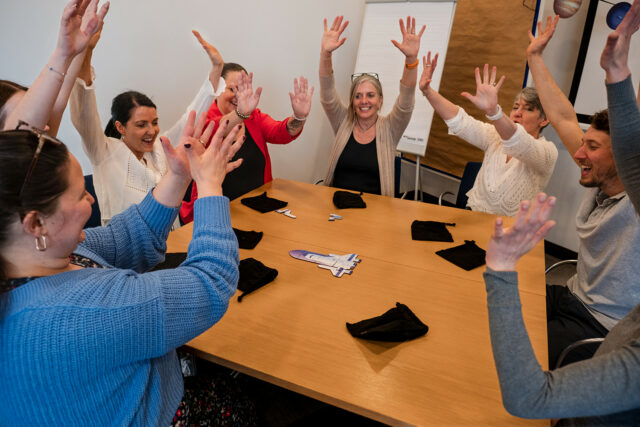
Energizer Games: How to Boost Engagement in Meetings
Activation games are a real game changer for meetings, as they get rid of the meeting grump from both sides: The participants are motivated again and the moderator gets an attentive audience again – a win-win situation.
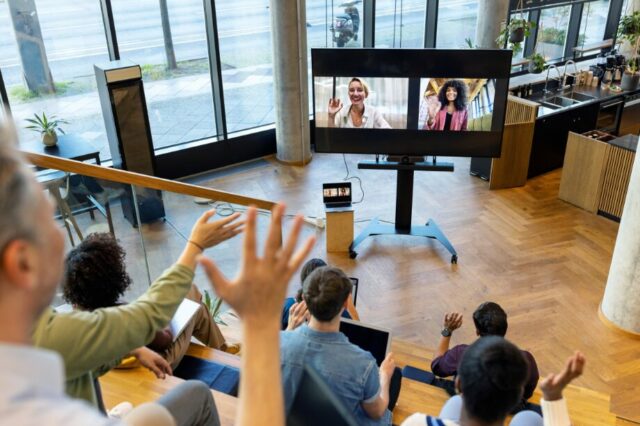
Planning and facilitating hybrid team-building events 2026
In 2026, hybrid team-building will be one of the key challenges for companies that want to truly bring their teams together, regardless of where they work.

Trainee onboarding with Cake Factory
Team spirit meets sweet success: at the Cake Factory, trainees experience first-hand how important communication, understanding roles and cooperation are in everyday working life. In an exciting simulation game centred around cake production, the team grows closer together with every round – from initial chaos to perfect coordination. An entertaining and educational trainee event that is guaranteed to be remembered!