

Team-building for fast-growing SMEs in 2026

Team-building for fast-growing SMEs: A guide to sustainable growth
When a small or medium-sized business experiences rapid growth, the dynamics within the team often change within a short space of time. New colleagues join, responsibilities shift, and processes that used to run smoothly suddenly reach their limits. At the same time, there is a risk that personal connections and the original sense of team spirit will be lost amid the hectic pace of everyday working life.
Anyone who focuses solely on professional expertise, new roles and additional processes at this stage overlooks a crucial factor for success: how people work together. Targeted team-building for SMEs is therefore more than just a company outing. When used correctly, it supports the company’s development, strengthens collaboration and helps to secure long-term growth.
Why team-building is crucial during a company’s growth phase
During a period of dynamic growth, SMEs face a twofold challenge. Whilst order volumes, responsibilities and workloads increase, it becomes more difficult to coordinate effectively within the team. This is particularly true when staff are working together across different locations or in hybrid working arrangements.
What used to work in a small team, thanks to short lines of communication and spontaneous discussions, requires clearer structures as the company grows. Without targeted staff development and reliable channels of communication, silos, misunderstandings and unnecessary duplication of effort can quickly arise.
Targeted team-building addresses precisely these points:
- Integrating new staff: Shared experiences make it easier to get to know one another and help to create a sense of belonging more quickly.
- Structuring collaboration: Clear roles, well-coordinated processes and effective team coordination minimise friction in day-to-day operations.
- Improving communication: Teams learn to share information in a more targeted way, make decisions together and address problems at an early stage.
- Retaining staff: Those who feel involved, valued and part of a well-functioning team are more likely to remain loyal to a company, even during challenging times.
Which team-building activities support your growth objectives?
Not every team-building activity is suitable for every situation. When selecting appropriate team-building activities, the focus should therefore not be on the activity itself, but on the question: What does our team currently need to successfully navigate the next stage of growth?
1. Integrating new staff and building trust
When a large number of new staff members join the company within a short space of time, different departments are merged, or colleagues have so far mainly got to know one another online, the priority is initially to get to know one another in person.
In this situation, low-threshold formats that facilitate interaction and exchange without putting pressure on individuals are particularly suitable. Working on tasks together helps to overcome reservations and allows initial personal connections to form.
Formats such as WUP or the Smart Team Challenge are particularly well-suited here, as they make it easy to get started and quickly encourage new team members to engage with one another.
The result: the ice is broken more quickly, personal relationships are formed, and new staff find it easier to integrate into the existing team.
2. Improving communication and team coordination
When handover procedures fail, tasks are handled twice, information is lost or responsibilities are not clearly defined, informal arrangements are often no longer sufficient.
It is precisely during the growth phase that teams must learn to coordinate tasks more systematically, share information transparently and make decisions in a way that is easy to understand. Formats in which participants have to plan, communicate and respond to changes together under time pressure are particularly well suited to this.
Turn Around is useful here because the format highlights typical patterns of communication and coordination, which can then be applied to day-to-day work.
This makes information flows more transparent, coordination more efficient and strengthens collaboration between different departments.
3. Clarify roles and responsibilities
As a company grows, roles change too. Small teams develop into departments, staff take on leadership responsibilities, and decision-making must be reorganised.
If it remains unclear who is responsible for what, delays and conflicts arise. Some staff members take on too much responsibility, whilst others wait for decisions or feel they are not sufficiently involved.
Formats in which tasks are allocated, decisions are made and responsibility must be visibly assumed are therefore helpful. The Cake Factory is well suited to this, as participants jointly manage a simulated production environment and thereby experience first-hand how roles and decisions affect the overall outcome.
This enables participants to reflect specifically on their understanding of their roles, their decision-making abilities and their ability to take responsibility.
4. Strengthening cross-departmental collaboration
As a company grows, silos can quickly develop. Individual teams or departments work efficiently in isolation, but pay too little attention to how their decisions affect other areas.
It is precisely at these points of interface that misunderstandings, delays and unnecessary coordination efforts arise. Team-building can help to refocus attention more firmly on the shared goal.
The Wind park is well suited to this challenge because several groups are working on different sub-tasks, but can only achieve the overall objective through communication and close coordination.
This makes it clear that a good individual result does not automatically lead to a good overall result. What matters is how well the different departments work together.
Four steps to an effective team-building programme
To ensure that a team-building event does not simply fizzle out as a one-off leisure activity, but actually supports the company’s development, clear planning is required.
1. Identifying specific needs
Before choosing a format, it is important to clarify where the biggest challenge lies. Is the main focus on getting to know new staff, improving communication, clarifying roles, or fostering collaboration between departments?
Brief discussions with managers and staff, or an anonymous survey, can be helpful. The more precisely the requirements are defined, the more effectively the right team-building activity can be selected.
2. Align the format with the target
Just because an event is popular doesn’t automatically mean it’s the right one. Whilst a relaxed format helps to strengthen relationships, communication problems or unclear lines of responsibility usually call for a more structured team-building exercise involving facilitated reflection.
The choice should therefore always depend on what the team needs to improve on next. Should they start by getting to know one another, improving their collaboration, or working more deeply on roles and behavioural patterns?
3. Providing regular impetus rather than one-off measures
In a dynamic growth phase, a single major event per year is often not enough. New staff join the organisation, roles change and teams are reorganised.
A more effective approach is to combine a larger-scale joint initiative with smaller, regular activities in day-to-day working life. In this way, team-building can make a continuous contribution to staff development and support change within the organisation.
One possible approach could begin with a relaxed icebreaker session and be supplemented later by a more in-depth format that examines communication, roles or decision-making processes in greater detail.
4. Applying insights to day-to-day work
The most important phase begins after the team-building exercise itself. Agreements and insights must be put into practice in day-to-day work in order to bring about lasting change.
For example, the team can establish new communication rules, document responsibilities or introduce regular, brief coordination meetings. A follow-up after a few weeks also helps to assess which changes are already working and where further support is needed.
How can SMEs recognise a good team-building programme?
Professional team-building activities should not only be entertaining, but should also align with the company’s development objectives. When making your selection, take particular care to ensure that the format is suited to the team size and the current challenge.
The tasks should require genuine collaboration and not simply consist of individual activities carried out in parallel. Equally important are professional facilitation, joint reflection and a clear link to day-to-day work.
This transfer of knowledge is particularly crucial in fast-growing SMEs. Only when the team understands what they can take away from the shared experience to apply to their day-to-day collaboration does an event become an effective contribution to the company’s development.
Conclusion: Growth requires strong teams
A well-planned team-building programme for SMEs is a direct investment in stable collaboration and sustainable growth. It helps companies integrate new staff more quickly, clarify roles and establish reliable team coordination.
It is crucial not to view team-building as a one-off exercise. Appropriate formats, regular opportunities for development and the consistent application of these principles in day-to-day work ensure that teams remain capable of taking action, even during a challenging phase of growth.
After all, long-term business success does not come about simply through having more staff, new customers or higher turnover. It arises, above all, where people make effective use of their skills and work together towards a common goal.

You might also be interested in
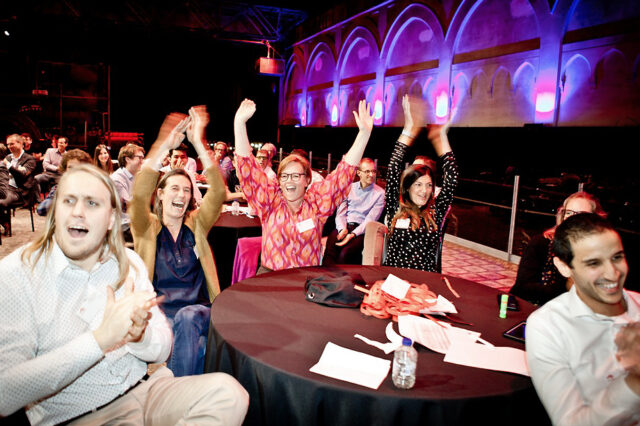
9 team-building ideas for companies
9 effective team-building ideas for companies that boost collaboration, trust and motivation – delivering tangible results rather than just a nice social programme.
It is high time to rethink employee motivation!
Whether we are motivated and efficient at work is strongly related to the DELIs. Whether teams realise their performance potential and whether it is fun to work in this team is also a result of motivation and appreciation.

Leadership that fosters growth—Why true greatness lies in the success of others
Leadership is changing, just like today’s working world. Whereas authority, control, and expertise often set the tone in the past, other things are now at the forefront: serving the team and the task of developing potential rather than suppressing it.