Our Responsibility workshop demonstrates how clearly defined roles and the promotion of personal accountability can significantly improve collaboration and success within the organisation. Responsibility is seen here as a key factor for success. Foster a new work culture in which personal accountability is recognised as a key factor for success. Contact us now to find out more about the workshop and book the Responsibility workshop for your team!
Following a brief introduction, the topic of ‘responsibility’ will be discussed. The session will not only explain what responsibility means, but also why it is an essential element of successful collaboration. The aim will be to raise awareness of personal responsibility and to establish an understanding of what responsibility means within a company, and which aspects are important for successful collaboration. The focus is on questions such as: Who is responsible for what? How does this affect group dynamics? And above all: What happens when responsibility is lacking?
What makes our workshops so special are the BITOU active modules. In the active modules, participants experience the effects of responsibility (or the lack thereof) first-hand. They take on different roles and see how different approaches affect the team.
Here is a case study: In the ‘Adventure Everest’ activity module, participants experience first-hand how important it is to have clear structures and responsibilities. Mistakes resulting from unclear areas of responsibility become immediately apparent here. This helps participants learn how to establish clear lines of responsibility in their day-to-day work.
Finally, the focus returns to everyday life. Which strategies from the workshop can be implemented immediately in the workplace? Participants develop concrete approaches to successfully embodying responsibility in the day-to-day workings of the team. Through these targeted reflection sessions, we aim to encourage participants to integrate responsibility into their professional lives in a sustainable way.
In a successful team, it is not just the manager or team leader who is responsible. Responsibility is everyone’s business. Whether in project management, communication or day-to-day collaboration – everyone has their role to play. But what happens when this sense of responsibility is lacking?
Overload due to unclear role allocation: If one person bears too much responsibility because tasks are not clearly allocated, this inevitably leads to being overwhelmed. There is too much weight on their shoulders – such a burden cannot be successfully managed in the long run.
Frustration when there is too little responsibility: On the other hand, someone who is not trusted with any responsibility will soon become frustrated. Because without responsibility, there remains the feeling of having no influence on the bigger picture. It is like sitting on the substitutes’ bench whilst the game continues without you.


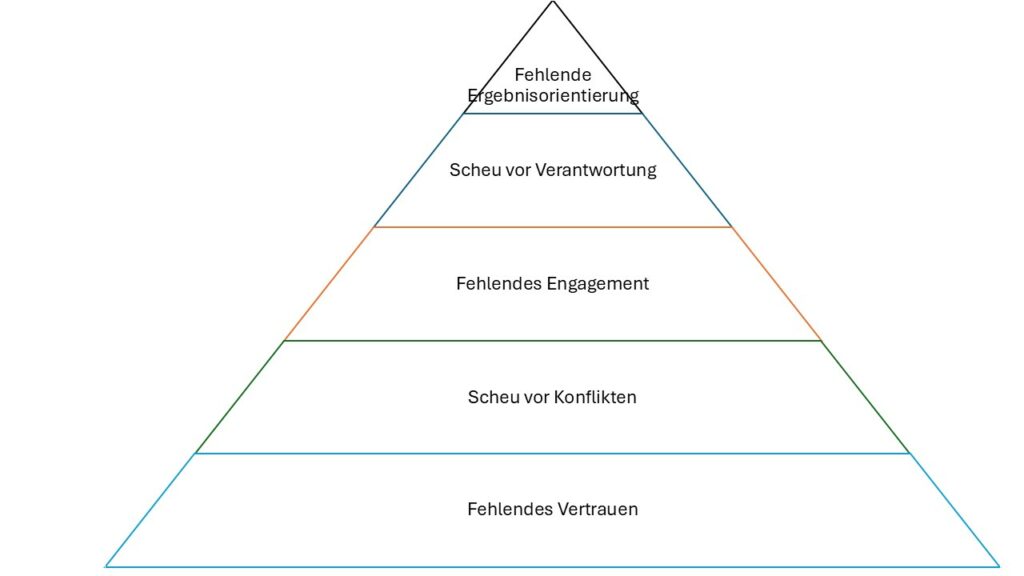
Patrick M. Lencioni’s model of the five dysfunctions states: the fear of accountability “is the unwillingness of team members to endure the interpersonal discomfort that arises when holding colleagues accountable for their behaviour, or, more generally, the reluctance to have difficult conversations. However, members of good teams overcome these natural tendencies and “enter the danger zone”” (page 172).
If you would like to find out more or carry out a team analysis based on your self-assessment, please feel free to take a look here.
Whether too much or too little responsibility is taken on, the consequences have been shown to have a negative impact on us as individuals, as well as on the success of the company. Issues such as psychological safety, communication and impact on the organisation can also play a role. These issues often come to light during the workshop, and the BITOU team trainer can respond accordingly. They analyse the results of the performance in the activity module, help your team recognise their potential, and provide you with personalised recommendations for better teamwork.
If you haven’t worked with us before and are curious to find out what our clients say about us, why not take a look at the client testimonials or read the Google reviews here?
The knowledge gained and experienced during the theoretical and practical parts of the workshop is now to be transferred into everyday working life. The participants are supported in this by the team trainers. We focus on practical approaches that ensure, right from the start, that what has been learnt takes root and bears fruit in everyday working life.
Responsibility must be experienced, tested and practised in real-life scenarios. That is why we combine theoretical principles with practical exercises. These exercises make it easier for participants to make the connection between theory and practice. In this way, we not only teach what responsibility means, but also how it is actually taken on and put into practice.
However, the learning process does not end on the final day of the workshop. We offer participants targeted support in applying what they have learnt to their everyday work. Our team trainers remain available after the workshop to discuss individual challenges and develop solutions. In addition, internal debriefings and feedback loops ensure that your team stays on track and integrates the topic of responsibility into their work processes in a sustainable way.
To ensure the smoothest possible transition into everyday working life, we provide participants with bespoke tools and techniques. These tools are designed to clearly define responsibilities and embed them within daily work processes. For example, responsibility charts or checklists can help to present responsibilities transparently. Where necessary, we adapt the tools flexibly to ensure they meet the specific requirements of each team.
With many years of experience in teamwork and consistent support, BITOU provides the ideal foundation for successfully integrating responsibility into everyday working life. The well-designed activity modules are practical, engaging and make complex topics accessible. BITOU ensures that participants not only gain theoretical knowledge, but can also apply it actively and sustainably in their teamwork.